Gigacampuses won’t drive the region’s growth – HUNDCA’s presentation at Data Center Event 2026
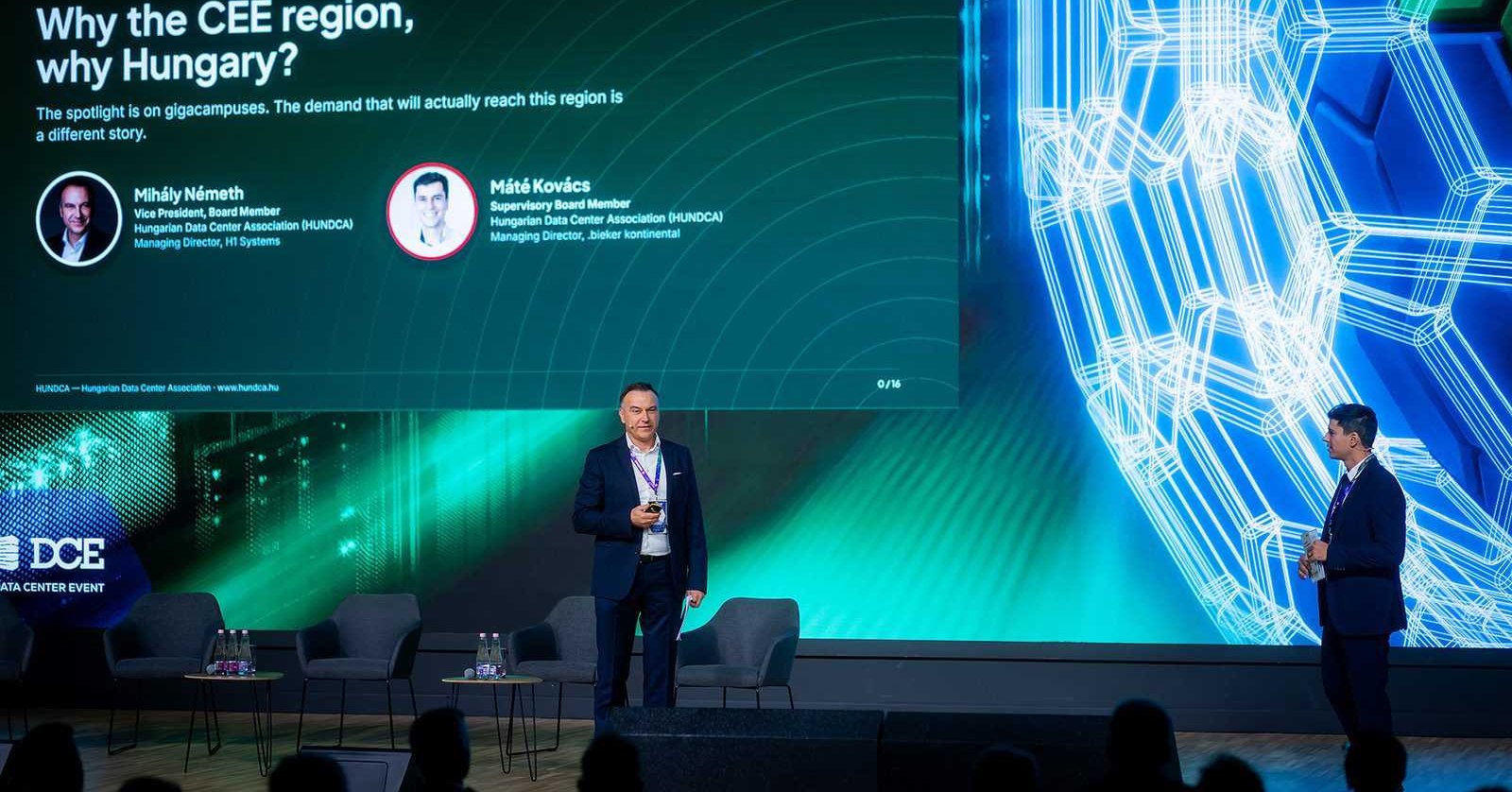
Data centre headlines are about gigawatt-scale American AI campuses, but a different kind of demand is reaching Central and Eastern Europe. This was the message of Mihály Csaba Németh, Vice President and Board Member of HUNDCA (H1 Systems), and Máté Kovács, Supervisory Board Member of HUNDCA (.bieker kontinental), in the Hungarian session of Data Center Event 2026 on 29 September.
Two layers of demand
According to Uptime Intelligence, 64% of the power in announced projects above 100 MW in the first half of 2026 is in North America. These AI training campuses go where energy is cheap and plentiful and land is available; latency does not matter to them. According to the presentation, the region’s growth will not come from them but from facilities ranging from a few megawatts to a few hundred megawatts where location matters: data centres serving AI inference and cloud regions, industrial AI factories, enterprise and sovereign data centres, and telecom edge data centres.
Four trends drive this demand. The European Commission aims to triple EU capacity within 5–7 years, with a balanced geographic distribution across Member States. According to CBRE, 63% of new European capacity in the second quarter of 2026 was already built outside the five traditional western hubs. McKinsey estimates that by 2030 more than half of AI compute will be inference, which runs close to users. And according to a Broadcom survey, the share of large companies running production AI primarily in the public cloud fell from 56% to 41% in one year.
What a site needs
Máté Kovács assessed the Hungarian situation against six requirements. Fibre connectivity is ready: BIX interconnects some 140 networks, and the Vienna–Budapest round-trip latency is 3.9 ms. The country is also ready in terms of water and climate, but after the drought of summer 2026, designs must use waterless or low-water cooling. The skills base is available from design to operation. Work is in progress on power, land and permitting: there is no one-stop shop yet, and acceleration zones are still to be designated. The gap is in data, as there are no public national data centre statistics.
As for location, Budapest is the most likely starting point, but the presentation also identified the areas of Győr, Miskolc, Debrecen, Szeged and Pécs as candidates, subject to power, fibre and water checks.
Shared foundations
According to the speakers, the gaps can be closed, but no single company or industry can close them alone. Industry can contribute data on planned capacity; grid operators can prioritise build-ready projects and offer transparent connection times; government can provide acceleration zones and project management with deadlines; and associations can run the first national survey and develop “data-centre-ready” site criteria. The closing message of the presentation: we may compete for projects, but we build the foundations together.